


Gaza : digging up the bodies from under the rubble
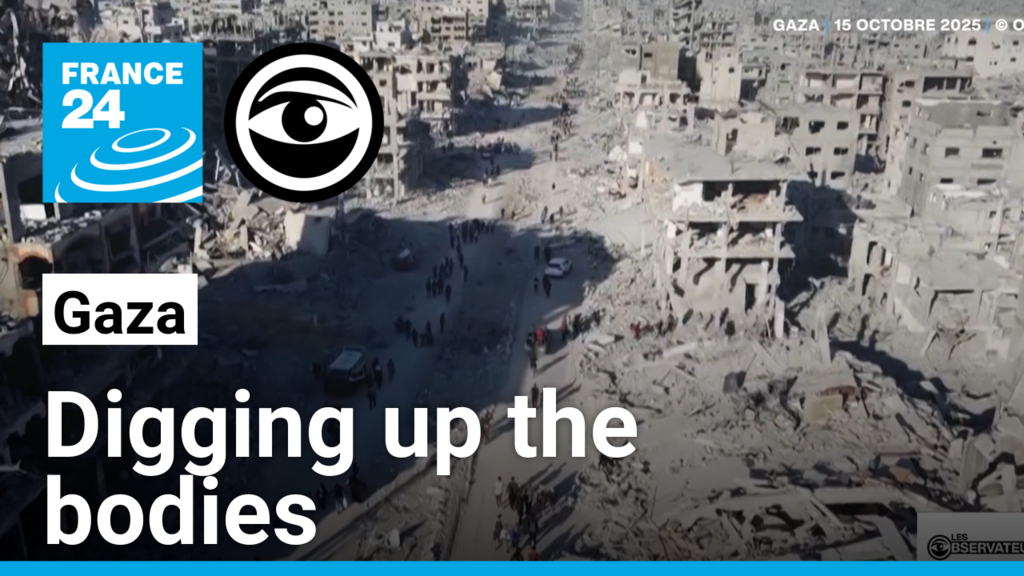
**One year after the October 10, 2025 ceasefire between Israel and Hamas, Palestinian Civil Defense teams continue slow, resource-starved efforts to recover bodies from under Gaza’s vast rubble.
Officials report roughly 1,000 bodies recovered so far (figures vary slightly by source and timeframe, with earlier tallies around 630–800 by mid-2026), while an estimated 8,000–10,000 remain buried. About 3,000 of those are believed to lie in areas still under Israeli military control (roughly 53–65% of the Strip, depending on the “yellow line” demarcation), where Civil Defense and the International Committee of the Red Cross (ICRC) have no access.
The underlying story originates from reporting around October 21–23, 2026 (notably France 24’s Observers), matching the details closely. The broader war (starting October 2023) produced an estimated 61–68 million tonnes of rubble—about 20 times the debris from all other wars in the prior 18 years, per UNDP estimates. Less than 2% has been cleared in accessible areas; full clearance could take 7–10 years and cost billions.
Scale of recovery and operational challenges
Civil Defense has run phased operations: a first phase from late November 2025 recovered around 333 bodies/remains from selected sites (out of an estimated 559 in those buildings); a second phase launched around July 2026 targeted additional homes (e.g., 147 sites estimated to hold ~1,072 bodies).

Recent recoveries include mass finds of 75, 96, 112, or smaller groups from specific family homes or buildings destroyed in 2023, often with high proportions of women and children. Many remains are highly decomposed—sometimes reduced to bones—after 2–3 years under concrete.

s), and at best one or two excavators/bulldozers/trucks, sometimes supported by the ICRC. Fuel, spare parts, protective gear, and specialized forensic equipment are scarce. Unexploded ordnance adds danger.
Officials have said recovery at the current pace could take 8–10 years. The ceasefire’s first phase reportedly envisioned entry of heavy machinery for debris removal and victim recovery, but Palestinian authorities and rights groups say Israel has blocked or severely restricted it (citing security concerns related to Hamas), while allowing more limited aid items.
Identification is rudimentary without reliable DNA testing capacity (reportedly restricted). Forensic teams document skeletal features (age, sex, height estimates), clothing, and personal effects, then show photos to families. Unidentified remains go to special cemeteries (e.g., one in Deir al-Balah held over 650 by mid-2026). ICRC assists with tracing, family links, and management of the dead.
Access, control zones, and rubble movement
Israeli forces withdrew to agreed “yellow line” positions under the ceasefire but retain control over large eastern and other areas. Civil Defense reports no access there; Mahmoud Basal (Civil Defense spokesman) and others have accused the IDF of clearing or compacting rubble in ways that may disturb or remove remains.
Satellite analysis by groups such as Forensic Architecture has documented compaction and removal of debris near military positions, sometimes linked to specific family homes where bodies were never recovered. Rights monitors and some reporting claim tens of millions of tonnes have been moved or trucked out in controlled zones, raising concerns about loss of remains and potential evidence.
Israel’s position, as reported in responses to UN statements and investigations, is that clearing follows operational/tactical necessity to reduce risks to troops, is conducted under international law and IDF directives, and that any bodies found are treated with respect, with efforts to coordinate handover. The IDF has denied accusations of erasing evidence.
ICRC has reported limited or no body handovers from Israeli-controlled areas in some periods (e.g., none since early 2026 in one account). Separate IDF searches for Israeli hostage remains have also occurred.
Humanitarian, legal, and longer-term angles
Families describe prolonged trauma from not knowing the fate of relatives and being unable to perform proper burials or mourning.
UN High Commissioner for Human Rights Volker Türk has highlighted that recovering remains (many of entire families, disproportionately women and children) years later compounds suffering and raises serious concerns about possible violations of international law, including war crimes.
He has called for full access for recovery, forensic documentation, biological sampling, and international investigators, noting Israel’s obligations regarding missing persons under international humanitarian law.
Rubble also contains hazards (asbestos, UXOs) that complicate both recovery and any reconstruction. Limited UNDP and partner efforts (supported by countries including South Korea, Norway, Japan, EU) have cleared smaller volumes for road access, schools, and basic services, recycling some concrete, but the scale dwarfs capacity. Overall Palestinian death toll figures cited in related reporting exceed 74,000 (Health Ministry), with additional post-ceasefire casualties from intermittent strikes.
Other angles include the political context of incomplete ceasefire implementation (disarmament, governance, further withdrawal remain contentious), the environmental burden of debris, forensic and evidentiary implications for accountability processes, and the psychological toll on recovery workers themselves. Progress on body recovery remains tightly linked to equipment access, territorial control, and the broader political stalemate.