


Some Afghans have admitted to giving their hungry children sleeping pills, while others have to sell their daughters and organs to survive. The world must act now to stop Afghans starving
Millions of Aghans are reportedly one step away from famine, as they have entered the second phase of winter since the Taliban take over and foreign funds no longer come.
Abdul Wahab an Aghan says, “our children have started crying and can’t sleep because they have no food to eat, and we the parents don’t have food to feed them.
Stating that “parents now go to pharmacy, and get sleeping pills to give to the children to help them sleep”.
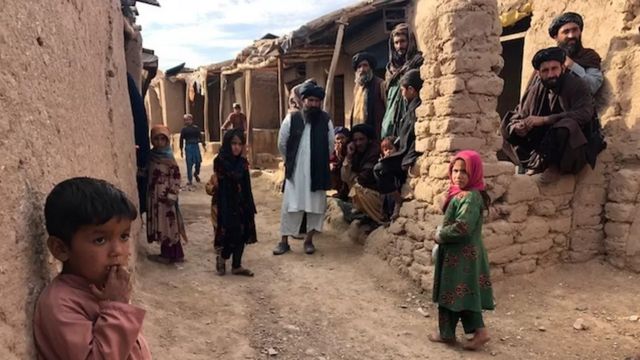
Abdul who says he live outside Herat in the country’s third largest city, a place where thousands of small-mud houses have been for many years, and filled with people who have been made homeless due to war and natural disasters.

Abdul says he is among a group of almost one dozen men who have to gather whatever they can find to feed. When ask how many of the parents gives their children drug to make them sleep?

He said say, “a lot of us, all of us”.![Nooruddin, who sold his kidney to raise money for his family, shows the scars from the operation at his house in the Khwaja Koza Gar area in Herat [Rouba El Husseini/AFP]](https://www.aljazeera.com/wp-content/uploads/2022/02/000_9Z36NQ.jpg?w=770&resize=770%2C1155)
“I had to do it for the sake of my children,” Nooruddin told News men in a city, close to the border with Iran.
“I didn’t have any other option.”
Afghanistan has been plunged into financial crisis following the Taliban takeover six months ago, worsening an already dire humanitarian situation after 20 years of war and United States occupation.
More than half of the country’s 38 million population suffers from acute hunger, with nearly 9 million Afghans at risk of famine, according to the United Nations.
The foreign aid that once propped up the country has been slow to return in the wake of US sanctions. The country’s economy is near collapse after international financial institutions cut funding and the US froze Afghanistan assets. US President Joe Biden earlier this month decided to withhold about $7bn in Afgan assets, repurposing half of the money as compensation to the victims of the 9/11 attacks.
Aid agencies and experts have called for the lifting of sanctions against the Taliban, saying the measures are worsening the humanitarian crisis.
The trickle-down effect has particularly hurt Afghans like Nooruddin, 32, who quit his factory job when his salary was slashed to 3,000 Afghanis (about $30) soon after the Taliban’s return, mistakenly believing he would find something better.
But, with hundreds of thousands unemployed across the country, nothing else was available.
Ghulan Hazrat brought out a strip of alprazolam tablets that they used in sedating their children to sleeping, the drug is meant for the treatment of anxiety disorders.

On November 8th, the World Food Programme (wfp), a un agency, said that its estimate of people “teetering on the edge of famine” worldwide had risen from 42m earlier this year to 45m. Remarkably, just one country accounts for almost all those 3m additional people. Afghanistan is on the brink of a humanitarian catastrophe.
Some 23m Afghans, in a country of 38m, face acute hunger. Of those, 8.7m are in a state of emergency, the second-highest category in the wfp’s hierarchy of calamity. The classification manual explains that by the time the agency declares a famine, the highest category, it will be too late to avert the worst consequences “because many will have died”.
The UN humanitarian chief has urged donors to restore funding for development in Afghanistan that was frozen when the Taliban took over a year ago, warning that six million people were at risk of famine.
Martin Griffiths told the United Nations Security Council that Afghanistan faces multiple crises – humanitarian, economic, climate, hunger and financial – and that donors should immediately provide $770m to help Afghans survive the coming colder months.
Conflict, poverty, climate shocks and food insecurity “have long been a sad reality” in Afghanistan, but he said what makes the current situation “so critical” is the halt to large-scale development aid.
“Poverty is deepening, the population is still growing, and the de facto authorities have no budget to invest in their own future. It’s clear to us that some development support needs to be restarted,” Griffiths said.
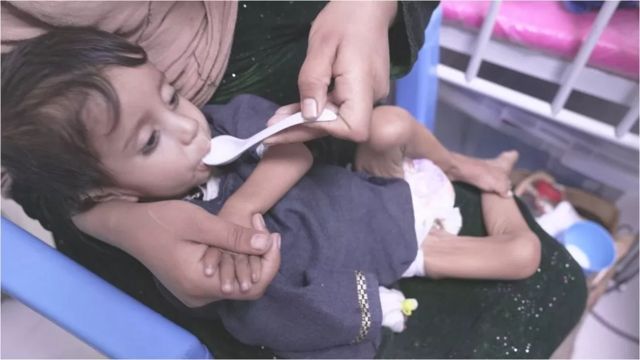
More than half of Afghanistan’s 39 million people need humanitarian help and six million are at risk of famine. More than a million children are “estimated to be suffering from the most severe, life-threatening form of malnutrition” and could die without proper treatment, he said.
“Afghanistan’s de facto authorities must also do their part. Bureaucratic interferences and procedures slow down humanitarian assistance when it is needed most. Female humanitarian aid workers … must be allowed to work unhindered and securely. And girls must be allowed to continue their education,” he said.
The Taliban has not been formally recognised by any foreign governments and is still subjected to international sanctions, which the UN and aid groups say are now hindering humanitarian operations in the country.

Ammar said ” we can only afford to eat once in every two days. After selling my kidney, I feel like a half person. I feel hopeless, if life continue like this, I will have no other choice than to die”.
Selling organs for money is not new in Afghanistan, even before the Taliban took over. But now, it has gotten even worse because of the price of a kidney no longer pay enough money for families of those are selling their kidney to survived on.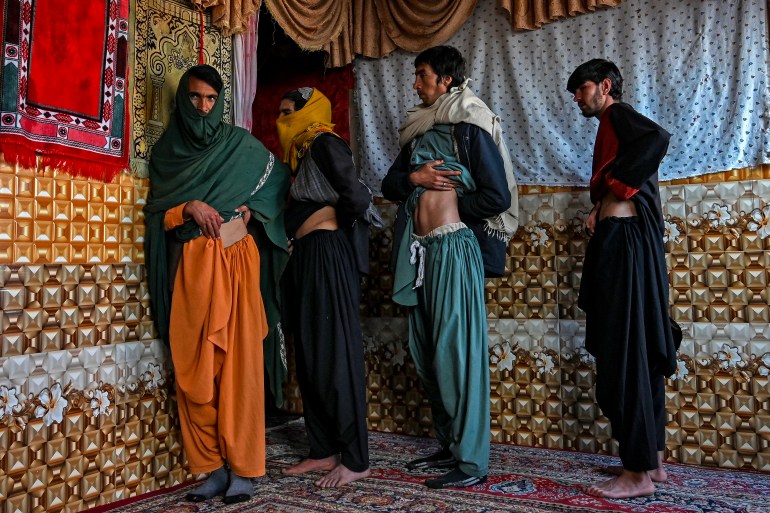

A kidney is sold for $1,500
Nooruddin was among eight people who had sold a kidney to feed their families or pay off debt – some for as little as $1,500.
In Afghanistan, however, the practice is unregulated.
“There is no law … to control how the organs can be donated or sold, but the consent of the donor is necessary,” said Mohammad Wakil Matin, a former top surgeon at a hospital in the northern city of Mazar-i-Sharif.
Mohamad Bassir Osmani, a surgeon at one of two hospitals where the majority of Herat’s transplants are performed, confirmed “consent” was the key.
“We take written consent and a video recording from them – especially from the donor,” he said, adding hundreds of surgeries have been performed in Herat over the past five years.
“We have never investigated where the patient or donor comes from, or how. It’s not our job.”
The Taliban did not respond to requests by AFP for comment on the practice, but Osmani said the country’s new rulers have plans to clamp down on the trade and are forming a committee to regulate it.
Afghans desperate for money are usually matched by brokers with wealthy patients, who travel to Herat from across the country – and sometimes even from India and Pakistan.
The recipient pays both the hospital fees and the donor.
Azyta’s family had so little food that two of her three children have recently been treated for malnourishment.
She felt she had no choice but to sell an organ, and openly met a broker who matched her with a recipient from the southern province of Nimroz.
“I sold my kidney for 250,000 Afghanis [around $2,700],” she said from her small damp room.
“I had to do it. My husband isn’t working, we have debts,” she added.
Now her husband, a daily labourer, is planning on doing the same.
“People have become poorer,” he said. “Many people are selling their kidneys out of desperation.”
He said the country’s banking and liquidity crisis, and the extreme difficulty of international financial transactions must also be tackled.
“The consequences of inaction on both the humanitarian and development fronts will be catastrophic and difficult to reverse,” Griffiths warned.
Billions of dollars in Afghan central bank reserves, held mainly in the United States, have also been frozen by foreign governments to prevent them from falling into Taliban hands. Russia, which called the UN Security Council meeting on the eve of the first anniversary of the US withdrawal from Afghanistan, and China have called for those funds to be released.
Russia’s UN Ambassador Vassily Nebenzia accused the US and its allies of abandoning Afghans to face “ruin, poverty, terrorism, hunger and other challenges”.
“Instead of acknowledging their own mistakes and supporting the reconstruction of the destroyed country,” he said, they blocked Afghan financial resources and disconnected its central bank from SWIFT, the dominant system for global financial transactions.
China’s UN Ambassador Zhang Jun also accused the US and its allies of “evading responsibility and abandoning the Afghan people” and imposing “political isolation and blockade”.
US Ambassador to the United Nations Linda Thomas-Greenfield said: “No country that is serious about containing terrorism in Afghanistan would advocate to give the Taliban instantaneous, unconditional access to billions in assets.”
Thomas-Greenfield said the US was the top aid donor to Afghanistan and criticised Russia and China: “If you want to talk about how Afghanistan needs help, that’s fine. But we humbly suggest you put your money where your mouth is.”