Von der Leyen pitches ‘associate member’ status for Canada: What does it mean for EU-US ties?
European Commission President Ursula von der Leyen has proposed creating a new path that could allow Canada to become the European Union’s first “associate member”, signalling a major potential expansion of ties between Ottawa and Brussels.
Von der Leyen made the proposal on Wednesday during her annual State of the Union address at the European Parliament in Strasbourg, with Canadian Prime Minister Mark Carney sitting in the front row.
“I would like to work with you on opening the door for Canada being the first associate member of the EU,” von der Leyen told Carney.
The proposal comes just days after Carney said Canada was seeking a “unique alliance” with the EU as Ottawa looks to strengthen its economic and security partnerships beyond the United States.
Carney has made clear that Canada is not seeking full EU membership. Instead, Ottawa has been exploring a closer relationship with the bloc that could provide greater cooperation in areas including trade, defence, technology, energy and critical minerals.
What would associate membership mean?
The term “associate member” does not currently have a defined status under EU treaties. Any such arrangement would therefore require the bloc to establish a new framework and secure agreement among EU member states.
Von der Leyen said the EU and Canada could build on their existing Comprehensive Economic and Trade Agreement (CETA) through a broader initiative described as an “Alliance for the Future”.
The proposed partnership could cover advanced manufacturing, defence production, Arctic cooperation, energy, critical minerals, batteries, artificial intelligence, quantum computing, cybersecurity and economic security.
The initiative comes as Canada seeks to reduce its heavy economic dependence on the United States amid heightened trade tensions with Washington.
Carney has been promoting stronger ties with Europe as part of Canada’s effort to diversify its international economic relationships. He has also backed increased cooperation with the EU in areas such as defence and trade.
Von der Leyen framed the proposed relationship around shared democratic values, arguing that Canada and the EU have common interests in determining their future partnerships.
The proposal is expected to receive further attention ahead of a planned Canada-EU summit in October, where both sides could discuss the scope and practical details of a closer relationship.
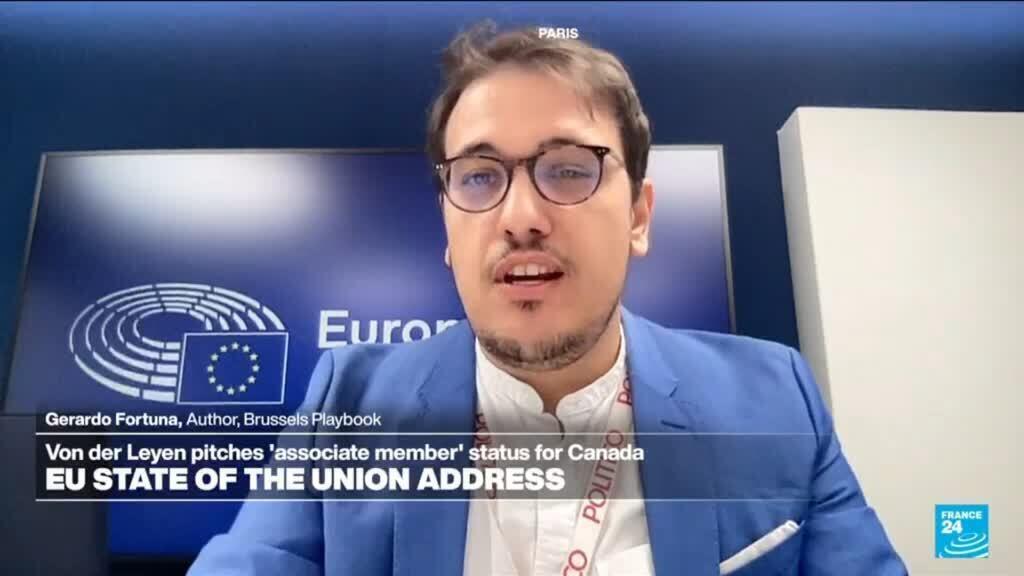
The development was also discussed in the context of wider EU-Canada relations, with Gerardo Fortuna, author of Brussels Playbook, among those following the negotiations and political debate surrounding the proposed alliance.
Fortuna’s recent reporting has focused on the EU’s efforts to draw Canada closer in areas including critical minerals, digital trade, education, skilled workers and Arctic security.
Key
Ed Sheeran: All supporting acts quit tour over Macklemore Palestine controversy
Von der Leyen gives state of the EU speech with Mark Carney in the room and AI on the agenda
Ed Sheeran’s tour in trouble after opening acts drop out in solidarity with rapper Macklemore
Middle East: Iran war exposes limits of US power
Ursula von der Leyen: EU chief pitches ‘associate member’ status for Canada
EU – Canada: Standing ovation for Mark Carney
Los Angeles: News helicopter crashes, killing three
France stalls EU Russia sanctions renewal over oligarch de-listing