


Italy’s trucker protests halt buffalo mozzarella production, cost producers €3m
Golden Page News | 23 October 2026

From Buffalo Mozzarella to AI Jobs: Fuel Shock and Artificial Intelligence Reshape Global Business
Italian truckers’ diesel protest disrupts a €3 million-a-day mozzarella industry as Barclays prepares to cut 5,000 jobs and Nvidia’s Jensen Huang urges ‘responsible optimism’ on AI
From the farms of southern Italy to the boardrooms of London’s financial sector and the artificial-intelligence laboratories of Europe, two powerful forces are reshaping business in very different ways.
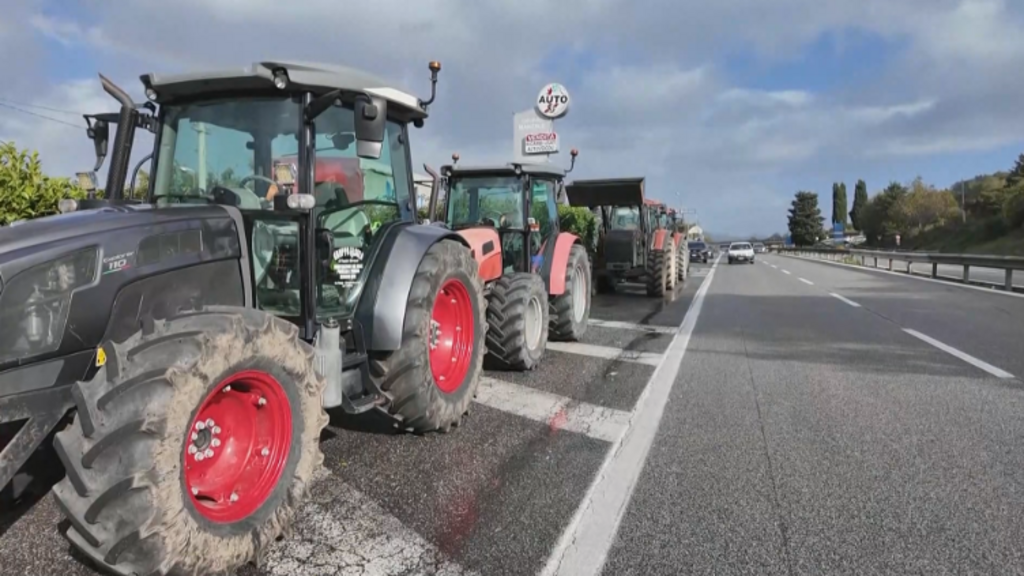
In Italy, soaring diesel costs and a truckers’ protest have disrupted one of the country’s best-known food industries, bringing buffalo mozzarella production in the Naples region to a halt and generating an estimated €3 million loss in just 24 hours.
At the same time, Britain’s Barclays has announced plans to cut approximately 5,000 jobs, or around 5% of its workforce, as it increases its use of technology and artificial intelligence to reduce costs.
And in Berlin, Nvidia CEO Jensen Huang is urging Europe to approach artificial intelligence with what he calls “responsible optimism”, arguing that the technology represents an enormous economic opportunity even as investors become increasingly nervous about AI-related valuations.

Together, the developments highlight a global economy caught between two competing realities: the rising cost of running today’s physical economy and the accelerating pressure to automate tomorrow’s economy.

🇮🇹 Italy: When Diesel Prices Stop the Mozzarella Supply Chain
The disruption in southern Italy began with a truckers’ protest over sharply rising diesel prices.
But its consequences have travelled far beyond the transport sector.
The protest has effectively interrupted the highly time-sensitive supply chain behind Mozzarella di Bufala Campana, the protected buffalo-milk cheese produced principally in the Campania region.
According to Pier Maria Saccani, director of the Consortium for the Protection of Mozzarella di Bufala Campana DOP, approximately one million litres of buffalo milk could not be processed because transportation blockades prevented the milk from reaching dairies.
The result was extraordinary: mozzarella production effectively stopped for a day, producing an estimated €3 million economic loss in 24 hours.
The problem is particularly severe because buffalo milk cannot simply be stored indefinitely.
Buffaloes continue to produce milk and must continue to be milked, while production rules for the protected cheese require the milk to be transformed within a limited period. Farmers generally do not have sufficient storage capacity to absorb a prolonged disruption in collection.
What began as a protest by transport workers therefore became a problem for farmers, dairies, distributors, supermarkets, restaurants and consumers.
The chain reaction
The mozzarella crisis is only one part of the disruption.
The week-long truckers’ protest has also affected the movement of food and other essential goods across parts of southern Italy.
Reports indicate shortages at supermarkets and disruptions at fuel stations, with parts of Sicily, Calabria and Puglia also experiencing supply problems. Panic buying has compounded some of the shortages.
The situation illustrates how dependent modern food systems are on transportation.
A farmer can produce milk, a dairy can have the equipment to manufacture cheese and a supermarket can have customers waiting to buy it — but if trucks cannot move between those points, the entire economic chain can stop.
The cost of the protest
The underlying issue is the rising cost of diesel.
Transport companies argue that increasing fuel costs are making it increasingly difficult to operate profitably, particularly in an industry where margins can already be tight.
The Italian government has responded with additional tax relief and financial measures aimed at truckers and farmers. Authorities approved measures worth hundreds of millions of euros, although it remained unclear whether the intervention would be sufficient to end the protest immediately.
The crisis therefore raises a larger economic question:
How much can governments absorb when energy costs rise across an economy?
If transport becomes substantially more expensive, the cost eventually reaches almost every sector — from agriculture and food production to construction, retail and manufacturing.
🇬🇧 Barclays: AI Moves From Experiment to Workforce Restructuring
While Italy’s transport crisis is demonstrating the vulnerability of the physical economy, Britain’s banking industry is demonstrating the disruptive potential of the digital economy.
Barclays announced on October 22 that it plans to eliminate approximately 5,000 jobs, equivalent to about 5% of its workforce, as part of a programme to reduce fixed costs and increase returns through technology, including artificial intelligence.
Approximately 1,000 positions have already been eliminated, with another 4,000 expected to go by the end of 2026, according to Barclays Chief Financial Officer Anna Cross.
The significance goes beyond the number of jobs.
Around 60% of the cuts are expected to affect support functions, including areas such as software development, according to Reuters reporting on the bank’s announcement.
That is notable because software and technical roles were once widely considered among the professions most likely to benefit from the technology revolution.
AI is now increasingly being used not merely as a productivity tool but as part of corporate decisions about how many people a company needs to perform particular tasks.
Profits and job cuts at the same time
Barclays’ announcement has also generated debate because it comes despite the bank reporting strong profits.
The bank reported approximately £2.3 billion in third-quarter pre-tax profit, up from the previous year, although the result fell short of analysts’ expectations.
That contrast raises an important question:
If companies are profitable, why are they using AI to reduce employment?
The answer lies partly in the changing economics of business.
AI can potentially perform repetitive administrative tasks faster, operate continuously and reduce the cost of processing large volumes of information.
For banks, that could mean automation across customer service, compliance, coding, document processing, research, risk management and other operational functions.
But the transition comes with a social cost.
Workers and unions have questioned whether companies are using AI primarily to increase productivity or whether the technology is becoming a justification for eliminating jobs without sufficiently investing in retraining.
Jensen Huang: Europe Should Be Optimistic About AI
Against this backdrop of job cuts and investor anxiety, Nvidia CEO Jensen Huang has been delivering a very different message.
Speaking in Berlin, Huang urged the world to approach artificial intelligence with “responsible optimism”, pushing back against extreme predictions that AI will inevitably destroy human civilisation.
Huang argued that excessive fear could distract from the enormous economic opportunities created by the technology. AFP reported that he criticised catastrophic predictions about AI as exaggerated attempts to attract attention.
His message to Europe has been particularly direct.
Huang has urged European countries, and Germany in particular, to accelerate AI adoption rather than allowing concerns about regulation to prevent businesses from taking advantage of the technology.
He has argued that Germany’s strength in manufacturing, engineering, automobiles and industrial machinery gives Europe an opportunity to combine its physical industrial expertise with AI.
His argument is essentially that AI should not be viewed only as a software revolution.
The next major phase could involve physical AI — robotics, autonomous vehicles, industrial automation and intelligent machines.
📉 But Investors Are Becoming More Nervous
Huang’s optimism comes at a complicated moment for financial markets.
AI-related shares have recently come under significant selling pressure as investors question whether the enormous amounts being spent on data centres, chips and AI infrastructure will ultimately generate sufficient returns.
On Thursday, the Nasdaq fell 2.6%, while Nvidia shares declined about 4.4% as technology and AI stocks came under pressure.
The sell-off has raised concerns about whether some AI companies have become too highly valued and whether the industry is spending too aggressively before the economic benefits have fully materialised.
Some investors are also concerned about the debt being accumulated to finance AI infrastructure.
This has created an unusual contradiction:
AI demand may be extremely strong, while investors are simultaneously questioning the financial model supporting that demand.
Huang himself has acknowledged that the challenge facing parts of the AI infrastructure industry is not necessarily demand, but access to sufficient capital to finance the enormous expansion required.
The Bigger Picture: Two Economies Under Pressure
The Italian mozzarella crisis and Barclays’ job cuts may appear unrelated.
One involves buffalo farmers and truck drivers.
The other involves bankers, software developers and artificial intelligence.
But underneath the headlines is a common economic question:
Who ultimately pays for rising costs and technological change?
In Italy, truckers are protesting because the cost of operating their vehicles has risen dramatically.
That cost is then transferred through the supply chain to farmers, food producers, retailers and consumers.
In banking, companies are investing in technology because they believe automation can reduce operating costs.
That can benefit shareholders and potentially make companies more efficient, but it can also mean fewer jobs.
In both cases, businesses are searching for ways to survive and remain competitive in an environment where traditional operating models are becoming more expensive.
The Human Cost of Economic Transformation
Behind every economic statistic are people.
The €3 million mozzarella loss represents farmers whose milk could not be processed, dairy workers whose production lines stopped, truckers whose livelihoods depend on affordable fuel and businesses waiting for deliveries.
The 5,000 Barclays positions represent thousands of workers and families facing uncertainty as their roles disappear or change.
And the AI investment boom represents another generation of workers who must decide how to adapt their skills as machines increasingly perform tasks once reserved for humans.
The transition will not necessarily mean that AI destroys all jobs.
History shows that major technological revolutions can eliminate some occupations while creating entirely new ones.
But the transition can be painful, particularly for workers whose existing skills become less valuable faster than they can retrain.
The International Monetary Fund and OECD have warned that AI could also deepen inequality between countries and workers if access to computing power, electricity, digital infrastructure and relevant skills remains uneven.
Europe’s Strategic Choice
For Europe, the challenge is therefore larger than whether to embrace or reject AI.
Europe must decide how to participate in the AI economy while protecting workers, businesses and consumers.
Huang’s message is that Europe risks falling behind if it moves too slowly.
His critics argue that rapid technological adoption without adequate safeguards could increase inequality, weaken employment protections and concentrate economic power in a small number of technology companies.
The answer may lie somewhere between those positions.
Europe could pursue AI aggressively while simultaneously investing in education, workforce retraining, digital infrastructure, energy capacity and responsible regulation.
From Diesel to Data Centres
The events unfolding across Italy and the financial markets offer a snapshot of a much larger transformation.
One economic system is being disrupted by the price of diesel.
Another is being transformed by the power of data and artificial intelligence.
The buffalo mozzarella crisis demonstrates how quickly a physical supply chain can collapse when transportation is interrupted.
Barclays demonstrates how quickly technology can change the economics of white-collar work.
And Nvidia represents the companies building the infrastructure on which the next generation of the global economy may depend.
The central question for governments, businesses and workers is no longer whether the economy is changing.
It is how society will manage that change — and who will benefit from it.
As Italy’s farmers wait for trucks, Britain’s bankers prepare for a smaller workforce and Europe’s technology industry races to build AI capacity, the global economy is sending a clear message:
The future of work, production and commerce is already being negotiated — one truck, one job and one algorithm at a time.
Golden Page News | Global Business & Economy
People. Ideas. Opportunities shaping tomorrow.